
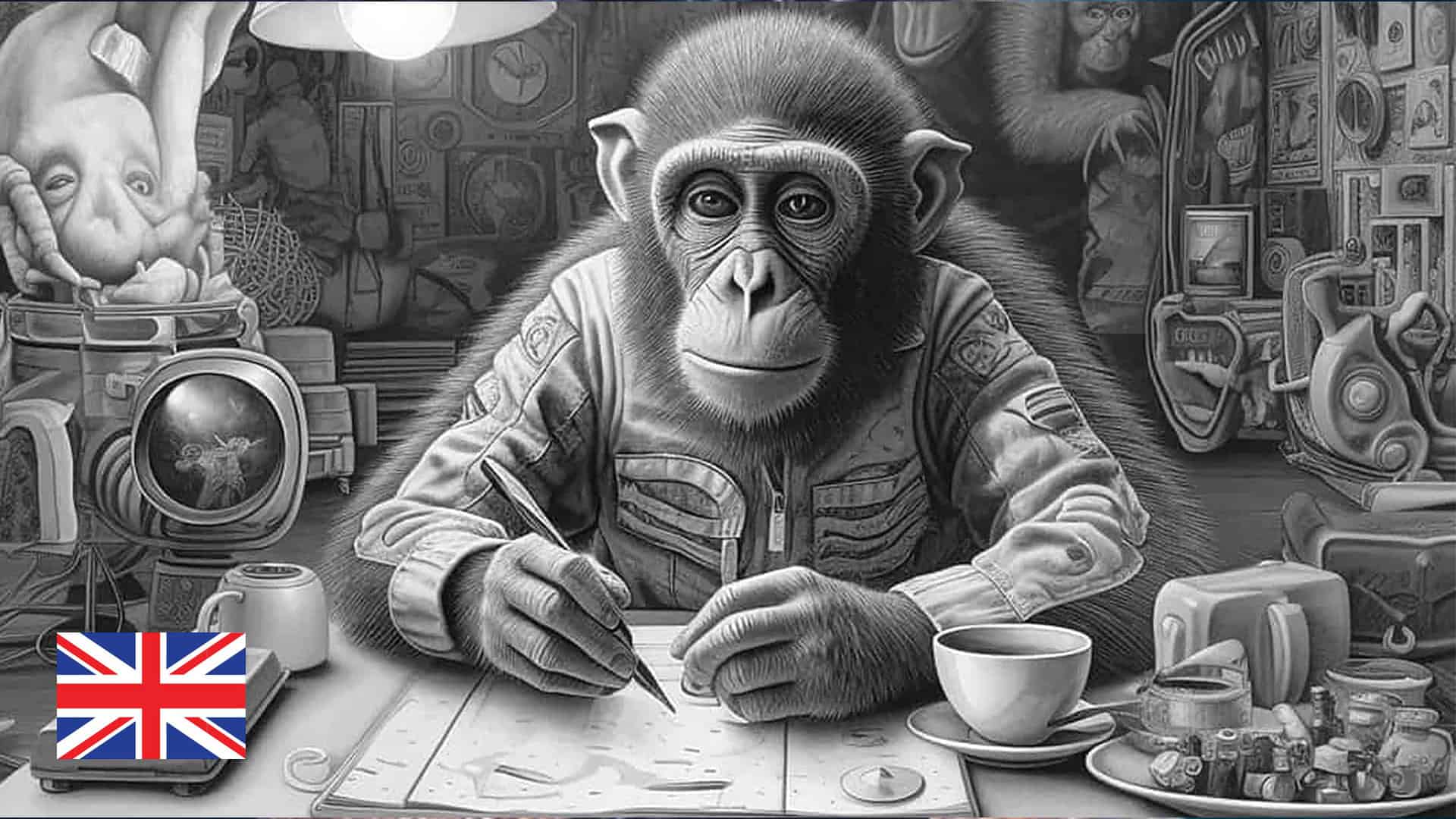
23 jun Monkeys thought outside the box when there weren’t even any boxes
I’ve been saying for a while now that I’m a “Darwinminion”, since in my studies on creativity, my views converge with those of the author of *On the Origin of Species*, or more precisely, “*”On the Origin of Species by Means of Natural Selection, or the Preservation of Favoured Races in the Struggle for Life”. And what does one have to do with the other? Let me explain. I believe that creativity is viscerally linked to our genetic evolution and continues to have a profound influence on the status of Homo sapiens. Creativity is not a gift, but rather, it is a biological tool for adaptation and, consequently, for survival. It is part of our genetic legacy and can be considered one of the main components of our behavior. This is why I believe that, among many other topics, evolutionary psychology is at the center of the discussion on creative processes and their outcomes.
Do you know about evolutionary psychology?
Evolutionary psychology is a branch of psychology that is based on Charles Darwin’s theory of evolution and seeks to understand how evolutionary processes have influenced the development of the human mind and behavior. This perspective holds that many aspects of human psychology, such as emotions, cognition, perception, and social behavior, are products of natural selection throughout our evolutionary history.
According to evolutionary psychology, humans possess a series of universal psychological characteristics that evolved to adapt to the challenges and demands of the ancestral environment in which our ancestors lived. These characteristics, known as “evolutionary psychological mechanisms,” are considered adaptations that helped our ancestors survive and reproduce.
Evolutionary psychology also addresses a wide range of topics, from sexual attraction and mate selection to language development, parental behavior, and social cooperation. It seeks to explain how these characteristics and behaviors evolved over time and how they contribute to the adaptation and reproductive success of individuals. And since creativity is also considered a cognitive skill, I have taken the liberty of placing it as the protagonist among these topics.
It is important to emphasize that evolutionary psychology is a theoretical and non-deterministic approach. It seeks to understand general patterns of human behavior but recognizes that there are individual variations and cultural influences that also shape human behavior, which I fully agree with.
The influences on our behavior
In my studies, I have concluded that there are, in fact, seven major elements influencing our behavior and, consequently, our creative capacity. The Heptagram, as I call this set of influences, includes elements such as Genetic Legacy, Acquired Patterns, Disciplinary Hormones, Social Imperative, Temporal Environment, Rational Thought, and Biochemical Alterations. I won’t go into detail about each one, as that would require a book. In fact, one will be coming soon.
As I said, creativity is a fundamental aspect when discussing evolutionary psychology because natural selection favors characteristics that increase the chances of survival and reproduction. It is clear to me that creativity has developed exponentially, to the point where it has become a significant evolutionary advantage, facilitating problem-solving and adaptation to new challenges.
Through creativity, humans have been able to generate new ideas, combine concepts in original ways, and find unique solutions to problems of all kinds and sizes. Thanks to creativity, clever apes have gradually learned to tackle, with enviable skill, the complex survival-related problems, such as obtaining food, shelter, and dealing with threats, thereby generating more comfort by making daily tasks easier.
Society has evolved greatly, of course, but our purpose as a species has not. We are indeed very creative, but we continue to work like animals to make money and, with it, secure food, shelter, and deal with threats, thereby generating more comfort by making daily tasks easier.
